[World | Home | Peacegames | Philosophy | Catalog | Site | Order]
These materials are printed inThe Philosophy Guidebook: Complete with Maps copyright 1997 by David Felder and available for $10.
Political Philosophy
Are we obliged to obey governments?
Challenge: All governments are unjustified.
Positions and Definitions
Political Philosophy discusses the justification of government.
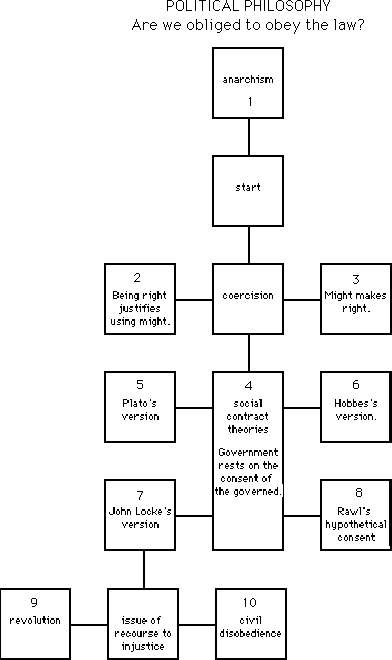
Anarchism (01)- The view that we should have no government.
Right justifies might (02) The view that those who know what is best should be allowed to make decisions.
Might makes right (03) The view that the strongest is entitled to rule.
Social Contract (04) theory is the view that a government is justified if and only if it has the consent of the people subject to it.
Plato (05) - We form governments to improve our living standard.
Hobbes (06)- We form governments to have security from others.
John Locke (07) -We form governments to protect our rights.
John Rawls (08) - Hypothetical Consent (Rawls) states that a government is legitimate if it is the sort of government we would agree to.
This attempts to answer the issue of proving consent.
Explicit Consent occurs when we actually state our consent.
Implicit Consent is assumed by our actions.
If a government depends on the consent of the governed it is possible for people to withhold their consent resulting in:
Revolution (09) When people no longer consent to a government.
Civil Disobedience (10) When people disobey a government.
Simulation Exercise on Political Philosophy (13.01S)
Protest Group Model
Suppose that there is a grocery store owner who is a Groat and whose customers are not Groats and who never hires non Groats to work in his store. As a non Groat you are upset over the grocery store owner's hiring practices and you are meeting with others to get the store owner to change her hiring policy.
1. What must any group do to be effective in changing a person's behavior? Must all the people in your organization agree on the demands that you state? Is it enough to just state demands?
2. Suppose that the grocery store owner rejects your request that she change her hiring policy. What can you do?
3. What does it mean to coerce someone to do something, such as coercing the grocery store owner to change her hiring policy?
4. If you say "Change your policy or else?" does that mean that you are using force? Is using force the same as using violence? What are the essential features of an "or else" condition for it to succeed?
5. Does political power always involve coercion? If a person says that they want to attain a goal by any means necessary then are they committed to using violence?
Return to Top
1-800-231-1638
© Copyright 1998 by David W. Felder. All rights reserved.